Standard baby size chart
| Height in cm | Age in months | Approximate weight in kg | Size to be ordered |
| 50 | 0 | 3. 3 | 1 month |
| 56 | 1 | 4 | 3 months |
| 62 | 3 | 5-6 | 6 months |
| 68 | 3-6 | 7-8 | 9 months |
| 74 | 6-9 | 8-9 | 12 months |
| 80 | 9-12 | 9-10 | 18 months |
| 86 | 12-18 | 11 | 2 years |
Standard size tables for girls and boys
| Height in cm | Age | Size to be ordered |
| 92 | 2 years | 3 years |
| 98 | 3 years | 4 years |
| 104 | 4 years | 5 years |
| 110 | 5 years | 6 years |
| 116 | 6 years | 8 years |
| 122 | 7 years | 8-10 years |
| 128 | 8 years | 10 years |
| 134 | 9 years | 10 years |
| 140 | 10 years | 12 years |
| 146 | 11 years | 12 years |
| 152 | 12 years | 14 years |
| 156 | 13 years | 14 years |
How to fit your child well!
Some practical tips ...
The primary function of the small child's shoe is to protect the foot from heat, cold, and injury, without hindering its mobility and perspiration.
During the first 3 years of life, the foot of a young child grows rapidly during this period. Between 9 months and 2 years, the foot will grow between 25 and 30mm. As a result, the foot will take a size every two months between 0 and 2 years, and every three months between 2 and 3 years. From 5 years old, the foot will grow by 1cm per year which corresponds to 1 to 2 sizes per year.
The child must acquire independent walking before starting the footwear. The walk is normally acquired between 9 and 18 months. Before the acquisition of independent walking, it is wiser to choose inside for a simple pair of non-slip socks.
It is essential to use a standing pedimeter as in this position the length of the foot can easily reach up to 1 cm. Finally, to be sure it's the right size, you have to be able to pass a finger between the child's heel and the shoe. This vacuum takes into account the growth and forward thrust movement of the foot during ground contact.
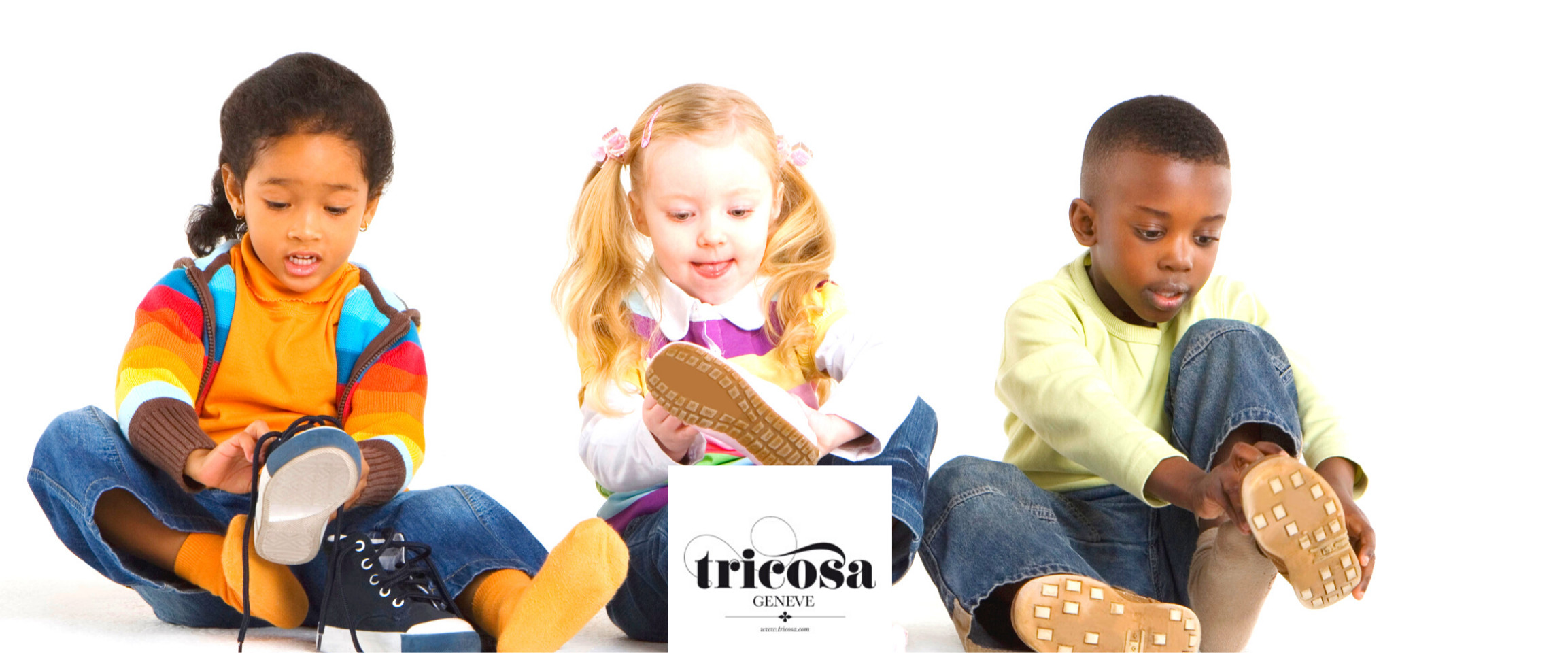
Therefore, the baby's shoe should:
- Be light.
- Be adjusted to the length of the foot.
- The upper of the shoe (top covering part) must be flexible and allow for the evacuation of the perspiration.
- Have a soft and non-slip sole.
- The front of the foot must be wide and rounded to make room for the toes.
- Have a heel with a maximum height of 5mm.
- For small feet, the shoes should be raised without being rigid to avoid unfitting too easily.
- Be closed by laces in small children to prevent them from systematically removing their shoes (velcros are advised for those who start school)
Therefore it is essential that the child be present when buying his shoes!
The entire Tricosa team will be delighted to welcome you and give you the best advice.